The Stars in Their Places
Good sentences give you fodder for contemplation.
I’ve come to adore the writing of Cormac McCarthy this past year. Right now I’m reading “All the Pretty Horses” and I want to share a sentence from that book.
The Context
John Grady and his pal, Rawlins, were preparing to sleep under the stars after a long day breaking wild horses. Oh, also, earlier that morning, John Grady had his first encounter with the daughter of Don Hector, the proprietor of the hacienda.
McCarthy has Grady and Rawlins laying on the earth next to a dying fire, the encounter with Hector’s daughter still ringing in the background of Grady’s mind. Then McCarthy drops this gem:
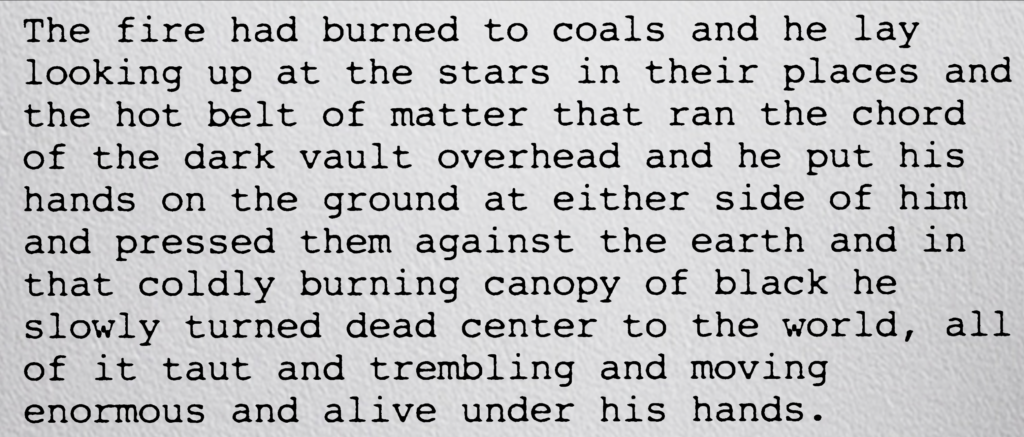
When I find good sentences like this, sentences that cast a spell on me, I cannot help but contemplate their tricks—hoping I might one day employ those tricks within sentences of my own.
Structure
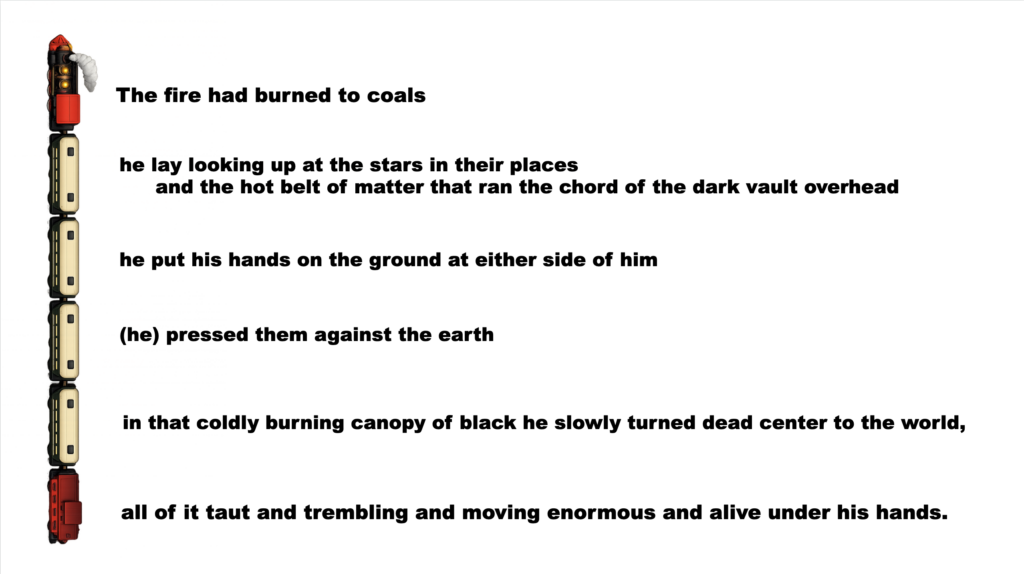
This sentence moves like a train.
That first clause is the engine, setting the scene.
This is followed by several more independent clauses.
Then, an absolute phrase as the caboose.
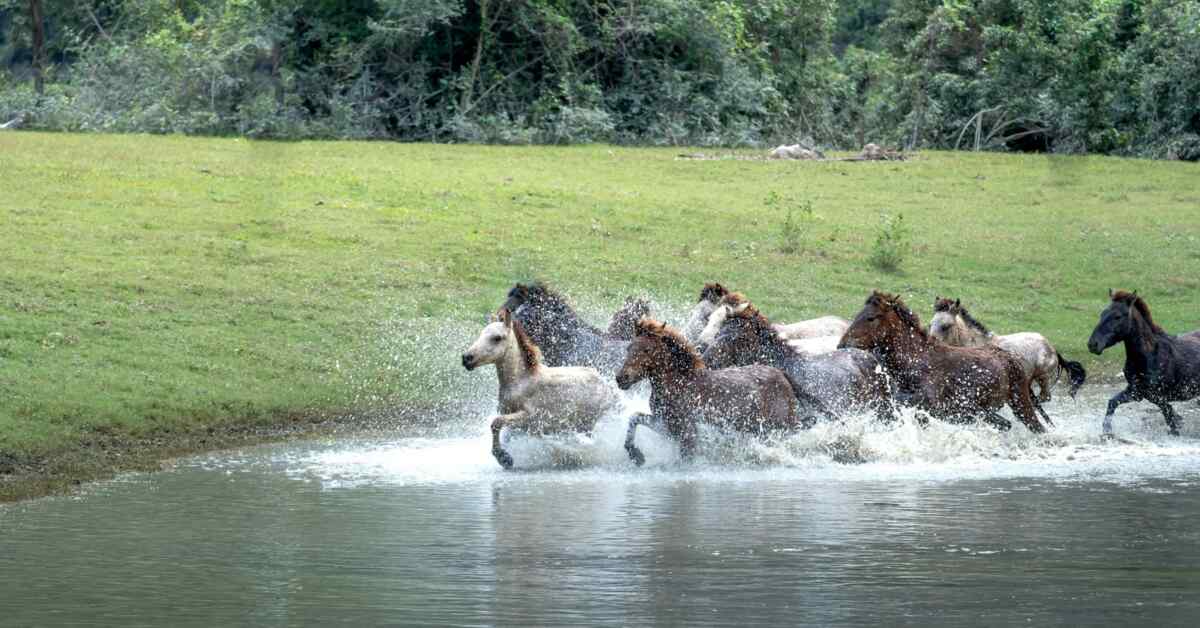
These clauses are paratactic, meaning each clause is simply lassoed into the herd, having no hierarchical priority. This is why “and” appears so often throughout the sentence.
If it were hypotactic, you would’ve found many ifs and thens, sinces, or althoughs, peppered throughout, clicking each clause firmly into an assigned slot.
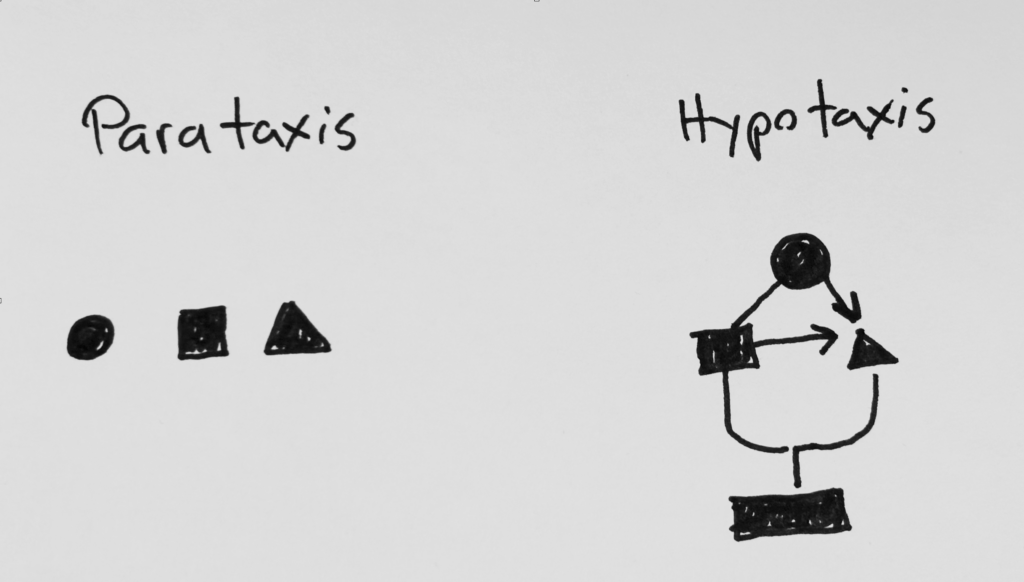
The paratactic style allows the momentum of the sentence to happen in a subterranean way. A momentum of “meaning” accumulates, not simply a rhetorical momentum of content.
Watch how Grady changes in this sentence. He first passively watches nature. Then he reaches out and touches it. Then he presses against it. Finally, he surrenders himself to it.
But what does it mean to surrender to nature?
Not much.
McCarthy wants us to see that Grady is surrendering himself to something else. But what?
We find the answer in the following sentences:
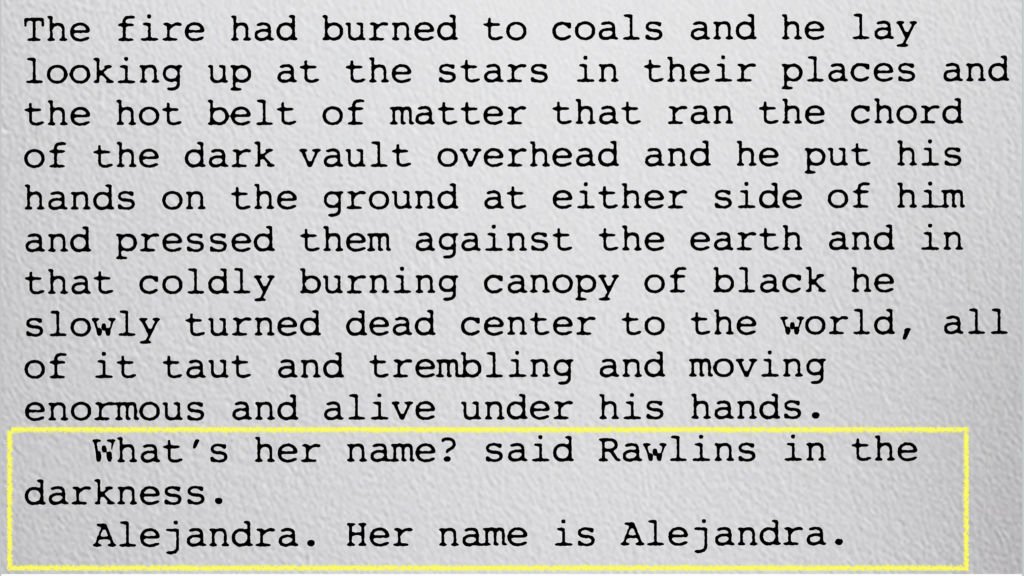
The universe was not the bigger thing Grady surrendered to.
It was love.
John Grady lay on the earth and surrendered his heart to Alejandra.
Now, with both sides of this sentence in mind—the hard day of breaking horses and Grady’s acquiescence to love—we can better see the wonderful work these clauses do in this delicious sentence.
Clause 1
“The fire had burned to coals”
McCarthy begins in the past perfect tense: “had burned.”
Why not “was burning,” or, “burned”?
McCarthy chose “had burned” to capture a sense of dying down, but not totally. It had not yet burned down “to ashes”—something cold and dead.
What was left still had heat, but a controllable heat. Those reckless flames were now gone.
What happened to the fire is what happened to Grady. Maybe the long day of wrestling down horses burned off Grady’s own uncontrollable passions—and his defenses.
Whatever the case, something intransitive happened to both the fire and Grady’s heart. In burning one thing away, something different was allowed to glow.
Clause 2
“he lay looking up at the stars in their places and the hot belt of matter that ran the chord of the dark vault overhead.”
McCarthy chose the simple past tense “lay” then fuses that right away to Grady’s “looking up.” In doing this, McCarthy collapses posture and perception into a single gesture. Grady isn’t lying down and *then* looking up. No, the looking is part of the recline.
Grady’s entire body moves into an act of attention, and he takes in the moment with his whole self. Whatever epiphany is working within Grady is something total.
Then, comes what Grady looks at. Not just “the stars,” but “the stars in their places.” What Grady sees is not arbitrary. It’s meant to be. The sky is ordered, and things are where they belong. In looking at the stars, Grady sees something divine. He sees a cosmos with intention.
Is love part of this order?
Does his heart, too, have a place to belong in this cosmos?
Then, “the hot belt of matter that ran the chord of the dark vault overhead.” This is the Milky Way, but also something more. It’s the cold realm engulfing the warmth of his newborn love, the darkness threatening to swallow that love’s light. He sees not merely space but a “vault,” a place to be either locked away for safe keeping, or to be trapped within.
“Belt of matter” is almost scientific, but also something as casual as a piece of clothing.
Then, “ran the chord,” technically, is geometric, a chord being the straight line connecting two points on a curve. But it also conjures up something musical, a dyadic chord being a harmony between two separate notes, like love itself.
Might Alejandra free Grady from his cold, dark vault?
Might Alejandra and Grady make music together?
Clause 3
“he put his hands on the ground at either side of him and pressed them against the earth.”
In my train image I broke this clause in two. But I analyze them here as one because they feel like a single motion.
After passively observing the order of the cosmos, Grady now acts. He puts his hands on the ground at his sides. He no longer lies there, but now braces himself to that spot.
It’s not the order of the cosmos for which he must brace himself, it is the shifting of his heart. He responds to these elemental realities, now, by pressing against them.
“Against” is an interesting word. You press against something that resists, something that pushes back.
Earth does not press back.
But love does.
Clause 4
“and in that coldly burning canopy of black he slowly turned dead center to the world”
Here Grady’s transformation completes, all while Grady presses against the dirt—an animalistic gesture, a humble posture. He has given himself over to something basic in the order of things; he has succumbed to love.
Having gone “dead,” he no longer resists. He is dead, not just to the prairie, or to the Hacienda, or to Mexico, but “to the world.” He is “dead center,” or, precisely where he must be. The “slowly” turning process doing its divine work in him has now finished.
Life remains cold and dark, but there is a heat burning, and the “vault” has now softened to a “canopy,” and Grady has now shifted to the place he must be: right there in that spot, in the grand scheme of things.
Clause 5: The Absolute Phrase
“all of it taut and trembling and moving enormous and alive under his hands.”
This final absolute phrase gathers up all the clauses into a single, undifferentiated whole.
Now, at the end, that coldness, that blackness, that vault, that deadness, it’s all been pushed away by something “enormous” moving beneath him, carrying him, something “alive” that he might now touch with his hands.
Final Thoughts
The closest thing I have to a writing mentor would be Verlyn Klinkenborg. Of the many lessons I’ve learned from Verlyn, McCarthy excels at one: write with implication.
Says Klinkenborg:
“Implication should be one of your goals. Implication is almost nonexistent in the prose that surrounds you . . . It was nonexistent in the way you were taught to write. That means you don’t know how to use one of a writer’s most important tools: the ability to suggest more than the words seem to allow, the ability to speak to the reader in silence.”
McCarthy is a master of implication. His sentences thump along in dull rhythms, but ring with an uncanny actuality that leaves you knowing more than the words seem to allow.
• • •
Thanks for reading my reflections on this great sentence.
I love breaking down good writing like this. Let me know if you enjoy this sort of thing, too.
Dan Kent